Happy Friday! Welcome to the 8th instalment of the Coinbyte Weekly Wrap.
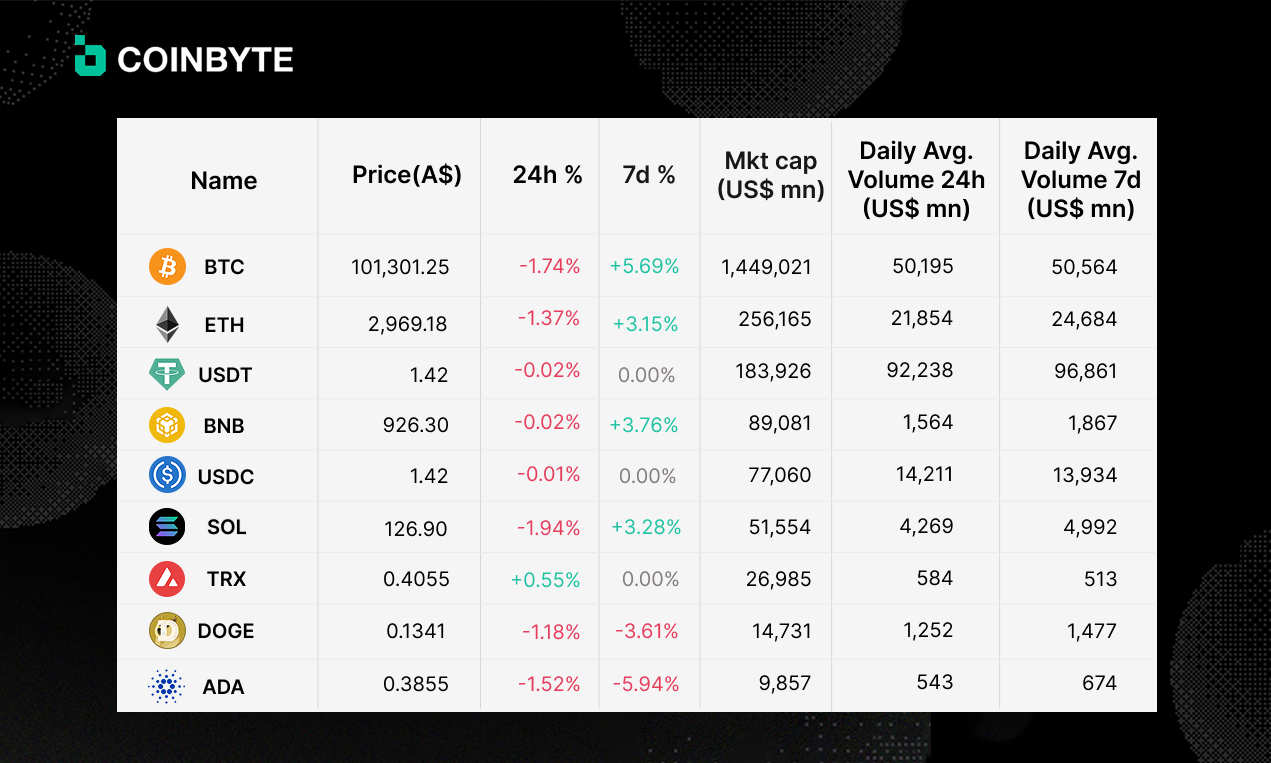
The market posted a firmer performance than last week, with BTC rising from A$94,885 to A$101,301 and delivering a weekly gain of 5.69%, compared with 1.8% in the prior week. Ether also stayed positive at +3.15% over the past seven days, while BNB and Solana advanced 3.76% and 3.28%, respectively. By contrast, higher-beta altcoins lost momentum, with Dogecoin down 3.61% and Cardano falling 5.94%, suggesting a more selective risk appetite compared with the broader rally seen last week. Trading activity was mixed across major cryptocurrencies, with BTC spot turnover holding broadly steady at around US$50.6bn in daily average 7-day volume, while ETH, USDT, and SOL volumes softened week over week. USDT trading volume eased from roughly US$107.7bn to US$96.9bn. Overall, this week’s price action points to continued strength in large-cap crypto, led by Bitcoin, while participation across altcoins and trading volumes became more uneven.
This week highlighted continued momentum in the convergence of crypto, traditional finance, and regulatory frameworks. Institutional activity remained strong, with PayPay moving toward a Nasdaq listing to expand its digital payments business, Morgan Stanley advancing plans for integrated digital asset services, and a16z Crypto targeting a new $2 billion fund that signals sustained long-term conviction in the sector. On the regulatory side, U.S. policy debates intensified as President Trump pushed for swift passage of the Clarity Act and publicly backed the crypto industry in its dispute with banks over stablecoin yield. Meanwhile, global infrastructure development continued to accelerate: major European banks under the Qivalis initiative progressed on a euro-backed stablecoin, Hong Kong and Shanghai deepened blockchain cooperation for cross-border trade finance, and the Bank of Japan explored blockchain-based settlement experiments aimed at enabling near-instant, 24/7 transactions. Elsewhere, corporate crypto exposure remained in focus, with SpaceX’s bitcoin holdings fluctuating with market conditions and Strategy adjusting preferred share dividends amid continued weakness in its common stock—underscoring both the growing integration of digital assets into mainstream finance and the volatility that still defines the space.
Performance
Newsflow
Regulation | Trump Urges Congress to Pass Clarity Act
U.S. President Donald Trump has urged Congress to swiftly pass the Clarity Act and criticized major banks for attempting to undermine the stablecoin framework established under the Genius Act. The dispute centers on whether crypto platforms should be allowed to offer yield on stablecoin balances, which banks argue could draw deposits away from the traditional banking system. Posting on Truth Social, Trump sided with the crypto industry, accusing banks of obstructing progress and calling for cooperation between regulators, financial institutions, and the crypto sector to advance a comprehensive digital asset oversight framework.link

Institution | PayPay Files for Nasdaq IPO
SoftBank-backed PayPay filed a preliminary prospectus on March 2 to offer 55 million ADRs at $17–20 per share, targeting roughly $1.1 billion in proceeds at a potential $13.4 billion valuation. The company plans to list on Nasdaq as it seeks to expand its digital payments business.link
Infrastructure | Andreessen Horowitz’s dedicated blockchain venture arm, a16z Crypto, is targeting approximately $2 billion for its fifth crypto-focused fund, with plans to complete the raise by mid-2026. Sources familiar with the matter note that while this target is smaller than the firm’s $4.5 billion crypto fund launched in 2022, it reflects continued commitment to backing blockchain projects despite a broader market downturn and tighter venture liquidity. Led by long-time investor Chris Dixon, a16z Crypto’s fundraising activity underscores enduring institutional interest in selective, long-term deployment of capital into the digital asset ecosystem.
Blockchain | The Bank of Japan will experiment with using blockchain technology to settle central bank reserves held by commercial banks, Governor Kazuo Ueda said. The initiative will be conducted as part of a financial infrastructure “sandbox project” to explore potential improvements in settlement efficiency, including the possibility of near-instant, 24/7 transactions.link
Regulation | A U.S. federal judge has dismissed with prejudice all remaining state-law claims in a long-running class-action lawsuit against Uniswap Labs and its founder, finding that merely providing decentralized exchange infrastructure does not amount to substantial assistance in third-party fraud involving scam tokens. The ruling effectively ends the case at the district court level and reinforces the distinction between protocol developers and bad actors deploying fraudulent tokens, potentially influencing how U.S. courts assess platform liability across the digital asset ecosystem.link
Regulation | Turkey’s ruling Justice and Development Party has submitted a draft economic bill to parliament proposing a new crypto tax framework, including a 10% quarterly withholding tax on income and gains from cryptocurrency transactions on authorized platforms and a 0.03% transaction levy on sales and transfers facilitated by service providers. Profits from transactions outside licensed platforms would be taxed through annual reporting. The proposal reflects growing legislative efforts to formalize crypto taxation as digital asset use expands in the country’s economy.link
Stablecoin | Around 12 major European banks under the Qivalis initiative are jointly developing a euro-pegged stablecoin, backed 1:1 by the euro and targeted for launch in the second half of 2026. The consortium is in talks with crypto exchanges, market makers, and liquidity providers to ensure sufficient trading depth and secondary market liquidity, with the aim of listing the token on regulated trading venues. The project is being structured to comply with the EU’s Markets in Crypto-Assets (MiCA) framework and is expected to seek formal authorization, reflecting a coordinated push by traditional banks to build regulated euro-denominated digital currency infrastructure.link
Blockchain | Hong Kong and Shanghai authorities have signed a memorandum of cooperation to explore a blockchain-based platform linking cross-border cargo trade and trade finance data. The Hong Kong Monetary Authority, Shanghai Data Bureau, and National Blockchain Technology Innovation Center will research the use of distributed ledger technology to integrate trade records, electronic bills of lading, and related financing processes under initiatives such as Project Ensemble, connecting platforms like Commercial Data Interchange and CargoX to streamline documentation and enhance data integrity across jurisdictions.link
Institution | Morgan Stanley has indicated plans to offer integrated digital asset services, including Bitcoin custody, trading, staking, and related yield products, as part of a broader push into the cryptocurrency space. The firm filed for a national trust bank charter with the Office of the Comptroller of the Currency to establish a regulated entity, Morgan Stanley Digital Trust, that would support these services under federal oversight. The move reflects a trend of major traditional financial institutions building in-house digital asset infrastructure to better serve institutional and wealth management clients.link
Institution | SpaceX’s Bitcoin holdings have declined in market value ahead of a potential IPO filing. On-chain data indicates the company holds approximately 8,285 BTC, currently valued at around $545 million, down from roughly $780 million three months earlier due to Bitcoin price movements. The company has not reduced its holdings, and the change reflects mark-to-market volatility rather than asset sales. Any future IPO-related disclosures could provide greater transparency into how digital asset exposure is reflected in corporate financial reporting.link
Institution | Strategy Inc., the corporate entity formerly known as MicroStrategy and one of the largest publicly traded holders of Bitcoin, raised the annual dividend on its STRC perpetual preferred shares to 11.50% for March 2026, marking the seventh increase since the instrument’s launch. The adjustment aims to support STRC’s trading near its $100 par value amid broad weakness in the Bitcoin market. Meanwhile, Strategy’s common stock (MSTR) extended its losing streak to eight consecutive months, declining approximately 14% in February, underscoring divergent performance between the company’s financing vehicle and its primary equity amid volatile market conditions.link
Disclaimer: This newsletter and its contents are for informational purposes only and do not constitute financial, investment, or trading advice from BYTEATLAS PTY LTD, trading as CoinByte AU (“CoinByte”). CoinByte is not a licensed financial adviser. Readers should not make any investment decisions based on this newsletter without independent research and advice from a qualified professional. The information may be incomplete or inaccurate, and CoinByte makes no representations about its accuracy. Opinions expressed in quoted material are those of the original authors and do not necessarily reflect CoinByte’s views. Cryptocurrency is highly volatile and risky. Use of this information is at your own risk, and CoinByte is not liable for any losses arising from its use.
 Industry AnalysisCoinByte Weekly Wrap: ASIC Extends CFD Oversight, JPMorgan Reports US$50B InflowsHappy Friday! Welcome to the 40th instalment of the Coinbyte Weekly Wrap. The market traded in a relatively tight but volatile range this week, with Bitcoin moving between approximately US$79,700 and US$84,200 before stabilising around US$82,200. BTC briefly climbed above US$84,000 early in the week
 Industry AnalysisCoinByte Weekly Wrap: CFTC Proposes New Crypto Rules, Bitcoin Nears Key Technical SignalHappy Friday! Welcome to the 39th instalment of the Coinbyte Weekly Wrap. The market traded on a weaker footing this week, with Bitcoin moving between a weekly high of around US$86,972 and a low of approximately US$80,337 before settling at around US$81,809. Based on the seven-day data provided, BTC
 Industry AnalysisCoinByte Weekly Wrap: Altcoin Volume Nears 4× BTC, Crypto Adoption ExpandsHappy Wednesday! Welcome to the 38th instalment of the Coinbyte Weekly Wrap. The market traded on a softer footing this week, with Bitcoin moving between a high of US$87,265.49 and a low of US$82,570.72 over the past seven days. BTC is currently priced at US$83,089, compared with a Sep. 23 close of U